
Ballet
Ballet is an artistic dance form performed to music using precise and highly formalized set steps and gestures. Classical ballet, which originated in Renaissance Italy and established its present form during the 19th century, is characterized by light, graceful, fluid movements and the use of pointe shoes. Ballet is considered the foundation in dance.
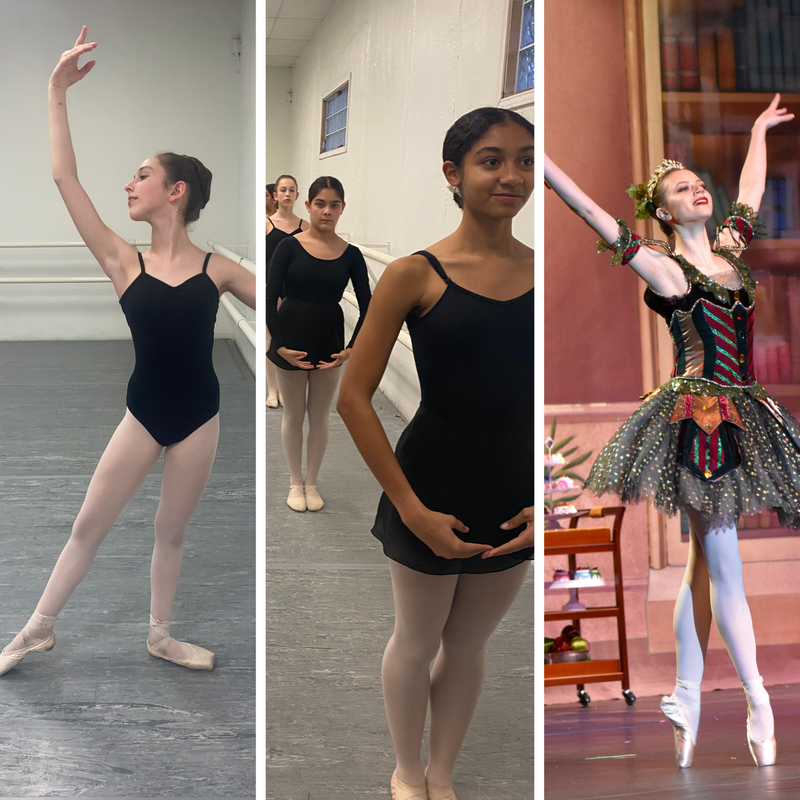
|
Ballet 1 - Beginning Ballet (Ages 6-8)Level 1 Ballet class is an independent, introductory ballet class designed for students who have little or no prior ballet experience. In this class, students will learn the fundamental techniques of classical ballet, including basic positions, movements, and terminology. The class typically begins with a warm-up session, which includes stretching exercises to improve flexibility and coordination. The warm-up is followed by exercises to develop basic ballet skills such as pliés, tendus, relevés, and jumps. Students will also learn basic ballet combinations, which will help them develop their musicality and movement quality. Throughout the class, students will be taught the importance of proper posture, alignment, and technique. They will also be encouraged to develop their confidence and self-expression through movement. This class is suitable for anyone who is interested in learning ballet, regardless of age or physical ability. The class is taught in a supportive and encouraging environment, and students are encouraged to progress at their own pace.
Recommendations:
|
Ballet 2 - Beginning Ballet (Ages 8-10)
Level 2 Ballet is a continuation of the introductory course for beginners who have completed Level 1 Ballet or have some prior experience in ballet. The class is typically aimed at students aged 8-10 years old, although this can vary depending on the individual student's level of experience. This class is designed to build upon the foundation laid in Level 1 Ballet and introduce more complex concepts and techniques.
In Level 2 Ballet, students will focus on developing a deeper understanding of proper technique and alignment, and will learn more challenging ballet steps and combinations. Barre work will be expanded to include more complex exercises, and center work will introduce turns and jumps.
Overall, this class will provide a solid foundation for those looking to advance in ballet and pursue higher levels of training. It is recommended that students have completed Level 1 Ballet or have equivalent experience before enrolling in Level 2 Ballet.
Requirements:
In Level 2 Ballet, students will focus on developing a deeper understanding of proper technique and alignment, and will learn more challenging ballet steps and combinations. Barre work will be expanded to include more complex exercises, and center work will introduce turns and jumps.
Overall, this class will provide a solid foundation for those looking to advance in ballet and pursue higher levels of training. It is recommended that students have completed Level 1 Ballet or have equivalent experience before enrolling in Level 2 Ballet.
Requirements:
- Minimum 1-2 years of previous ballet training
- Must wear uniform.
- Currently enrolled in a minimum of 2 hours of ballet a week.
Ballet 3 - Intermediate Ballet (Ages 11+)
The Level 3 Ballet Class is designed for intermediate ballet dancers with a solid foundation in classical ballet technique. This class focuses on refining and building upon the technical skills learned in previous levels while introducing more complex movement sequences and combinations. The class begins with a thorough warm-up, including exercises at the barre and in the center to strengthen and stretch the muscles. Students will then progress to more advanced techniques such as pirouettes, petite allegro, and grand allegro, as well as more complex port de bras and adagio combinations. Throughout the class, students will work on developing their artistry and musicality through the use of dynamics, phrasing, and expression. They will also continue to improve their knowledge of ballet terminology and develop their ability to execute movements with precision and control. The Level 3 Ballet Class is suitable for dancers who have completed at least two years of ballet training at Level 2 and have a strong understanding of the fundamentals of classical ballet. It is also appropriate for experienced dancers who wish to refine their skills and deepen their knowledge of ballet technique. Overall, this class is designed to challenge and inspire intermediate dancers, while providing a supportive and encouraging environment for continued growth and development.
Requirements:
Requirements:
- Minimum 3-4 years of previous ballet training.
- Currently enrolled in a minimum of 3 hours a ballet a week.
- Must wear uniform.
- Must attend class regularly.
- Academy Director's approval.
Alamo City Arts Academy
Criteria for Pointe work
**Pointe work is not required to study at the advanced level, but those wishing to study pointe must meet the following criteria:
- The student must be at least 12 years old. The bones of the feet do not fully develop and harden until approximately 13-15 years old. A dancer must be strong enough to protect the bones before they are fully developed. Beginning pointe too early can permanently damage immature bones.
- The student must have a healthy muscle structure.
- The student must have enough of an arched instep to stand on pointe.
- The student must have at least 3 years of consistent training in ballet.
- The student must be taking a minimum of 2 (4 hours) ballet classes a week consistently.
- Be able to hold correct turnout while dancing from foot flat to demi-point. Correct turnout is achieved from the hips and not from the feet and knees. In the turned-out position, the foot is in line with the kneecap and hip joint. Correct turnout should be easily maintained in demi-pointe. Weight centered forward over the big toe, heels forward to avoid sickling, and knees straight. Maintaining this correct turnout is more difficult en pointe.
- Be able to maintain a strong, straight torso while dancing without any tilt in the pelvis. A straight torso is held by both the back muscles but more importantly by the lower abdominals. A weak torso will throw the student off balance while en pointe and will make it difficult to do ballet steps. This also puts the dancer at risk for injury.
- Be able to perform a correct demi-plie position for all transitions. Demi-plie should be performed with turnout from the hips while maintaining the kneecap in line with the 2nd toe, and without allowing the heels to pop up. This should occur in pirouette preparation, jump preparation, and prior to en pointe positions.
- Pointing of feet: the dancer should be able to full pointe their foot in all steps especially at the barre and then in center without “sickling”. Achieving full pointe with stretching of the foot is required to get en pointe. Using the floor to point is also very important to build muscles in their feet and ankles: For example - need to slide the foot in and out on the floor
- Pique passé with straight leg. Student should have enough strength to push themselves onto half-pointe. This step is harder to do en pointe and a bent leg is usually a sign of weakness or improper step preparation.
- Be able to do 16 relevés in the center on half-pointe without stopping. Strength for pointe work is achieved by repeating exercises. Relevés are excellent for building up calf muscle strength, which is vital for pointe work. This exercise is more difficult to do en pointe because of the extra height, so strong relevés on half-pointe are a good sign of strength. The student must also go up as high on half-pointe as the dancer can since pointe work demands this ability. A student who keeps their heels very low to the ground is not preparing their calf muscles adequately and will not have the strength for pointe work.
- Be able to hold a passé balance on half-pointe. The student should be well-placed (hips square, back straight, legs turned-out), and have the strength to balance on half-pointe. This pose is more difficult to correct en pointe, as the surface area for balancing is smaller and the strength requirements are greater.
- The student must be in good health and able to take a whole class. If the student frequently needs to rest because of illness or injury, the dancer is not strong enough for the extra demands that pointe work requires.
Ballet 4 - Pre-Pointe - Intermediate Ballet (Ages 12+)
Pre-Pointe Ballet is a class designed for students who are preparing to transition from ballet flats to pointe shoes. This class aims to develop the necessary strength, technique, and alignment required for pointe work. Students will work on exercises to improve their balance, foot and ankle strength, and overall body alignment. The class will begin with a warm-up that focuses on developing the student's core strength and flexibility. This may include exercises such as planks, bridges, and stretches to improve flexibility in the hips, legs, and feet. The teacher may also include exercises to strengthen the ankles and feet, such as releves and tendus. After the warm-up, students will move on to center work, where they will focus on balance, alignment, and coordination. They will work on exercises such as pirouettes, adagio, and petit allegro to improve their technique and control. The class may also include barre work, where students will focus on proper alignment and technique. They will work on exercises such as plies, tendus, and rond de jambes, which will help to develop the necessary strength and control for pointe work. Throughout the class, the teacher will emphasize the importance of proper technique and alignment, as well as the importance of listening to and caring for one's body. Students will be encouraged to work at their own pace and to ask questions if they need clarification on any exercises. Pre-Pointe Ballet is an essential class for students who wish to pursue pointe work. It is recommended for students who have completed several years of ballet training and have developed the necessary strength and technique to begin preparing for pointe work.
- Minimum 3-4 years of previous ballet training.
- Currently enrolled in a minimum of 5 hours of intermediate ballet per week.
- Must wear uniform.
- Must attend class regularly.
- Academy Director's approval.
Ballet 5 & 6 - Pointe - Advanced Ballet (Ages 13+)
This advanced level ballet class is designed for experienced dancers who have a strong technical foundation and are looking to further develop their skills. The class will focus on refining technique, building strength and flexibility, and exploring complex movements and sequences. The class will begin with a thorough warm-up that includes exercises at the barre to help dancers develop proper alignment, balance, and control. This will be followed by center work, which will include adagio, pirouette, and petit allegro combinations that challenge dancers' coordination, musicality, and expressiveness. The class will also incorporate more advanced exercises and movements such as multiple pirouettes, grand allegro combinations, and intricate footwork. Dancers will be encouraged to approach these movements with focus, precision, and artistry, and to explore their own personal style within the framework of classical ballet technique. Throughout the class, emphasis will be placed on correct alignment, posture, and technique, as well as on musicality and expression. Dancers will be challenged to push their boundaries and reach new levels of excellence, while also being encouraged to enjoy the artistry and beauty of ballet. Overall, this advanced level ballet class is designed to provide a challenging and stimulating environment for dancers to further develop their skills, deepen their understanding of classical ballet technique, and explore their own unique artistic voice.
Requirements:
Requirements:
- Minimum 6 years of previous ballet training
- Currently enrolled in a minimum of 6 hours a ballet a week
- Must attend classes regularly
- Academy Director's approval
Adult Ballet - (Ages 15+)
This Adult Ballet class is designed for individuals who have a basic understanding of ballet technique and wish to further develop their skills. The class will focus on the refinement of ballet technique, body alignment, and musicality. The class will begin with a warm-up that focuses on increasing flexibility, strength, and proper alignment. The warm-up will include exercises at the barre, as well as center work, to prepare the body for more advanced movement. After the warm-up, the class will move into a series of ballet exercises designed to improve technique, balance, and coordination. These exercises will be tailored to the level of the class and may include pirouettes, jumps, and petit allegro. The class will conclude with a cool-down that includes stretching and relaxation exercises to prevent injury and reduce muscle soreness. The main goals of this class are to improve ballet technique, develop strength and flexibility, and enhance musicality. By the end of the class, students should feel more confident in their abilities and have a better understanding of how to apply ballet technique in a practical setting.